English
 Deutsch
 Français
 Norsk
 Suomi
 日本語
 Português
 Русский
 Čeština
 Ελληνικά
 हिन्दी
 ภาษาไทย
 中文
 Italiano
 Türkçe
 العربية
 עברית
 فارسی
 Español
 Nederlands
 Português (BR)
 Polski
 Svenska
 Bahasa Indonesia
 Tiếng Việt
 한국어

Short answer: the Martingale strategy wins small amounts often and loses a large amount rarely. It does not change the odds of any bet, so over time it cannot beat the house edge. It only changes when you win and when you lose. Below is the math, two tables you can check yourself and what to do instead.
What is the Martingale strategy?
The Martingale is the oldest and best-known betting system. You choose a bet that pays even money (1:1), such as red or black in roulette, a 2× target in crash or a 50% roll in dice, and follow two rules:
- Start with a small base bet.
- After every loss, double the bet. After a win, go back to the base bet.
When the win finally comes, it pays back every loss in the sequence plus a profit equal to your base bet. That is why the system feels unbeatable: almost every sequence ends with a small win.
A Martingale example with real numbers
Say your base bet is $1 on a 50/50 bet that pays 2×. You lose three times and win on the fourth bet:
- Bet 1: $1, lose (−$1 in total)
- Bet 2: $2, lose (−$3 in total)
- Bet 3: $4, lose (−$7 in total)
- Bet 4: $8, win $16 back (+$1 in total)
Four bets and $15 staked to make $1. A finished sequence always ends one base bet ahead, no matter how long it took.
How fast the bets grow
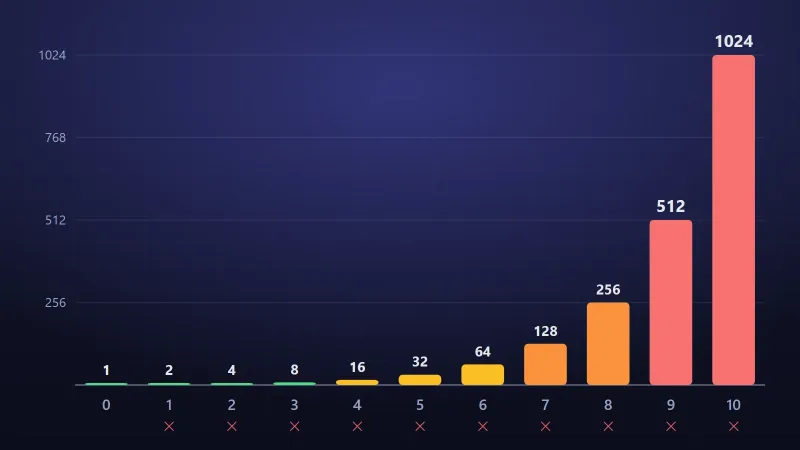
The catch is the doubling. Every loss doubles the next bet, so the money you need grows exponentially:
| Losses in a row | Next bet | Total staked, including the next bet |
|---|---|---|
| 0 | 1 | 1 |
| 1 | 2 | 3 |
| 2 | 4 | 7 |
| 3 | 8 | 15 |
| 4 | 16 | 31 |
| 5 | 32 | 63 |
| 6 | 64 | 127 |
| 7 | 128 | 255 |
| 8 | 256 | 511 |
| 9 | 512 | 1,023 |
| 10 | 1,024 | 2,047 |
Ten losses in a row turn a $1 base bet into a $1,024 bet, placed to win back a single dollar. Most players run out of money, or reach the game’s maximum bet, long before that.
How likely is a long losing streak?
On a fair 50/50 bet, the chance of losing 10 times in a row is 1 in 1,024, or about 0.1%. That sounds tiny, but you do not play one sequence: you play hundreds. Over 1,000 sequences, the chance that at least one of them starts with 10 losses in a row is about 62%.
| Losses in a row | Chance on a 50% bet | Chance on red in European roulette (48.65%) |
|---|---|---|
| 5 | 3.13% (1 in 32) | 3.57% (1 in 28) |
| 7 | 0.78% (1 in 128) | 0.94% (1 in 106) |
| 10 | 0.098% (1 in 1,024) | 0.13% (1 in 784) |
The math: why the Martingale cannot beat the house
Here is a clean example. With a bankroll of 1,023 units and a base bet of 1 unit, you can place ten bets in a row (1 + 2 + 4 + … + 512 = 1,023). On a perfectly fair 50/50 bet:
- 1,023 times out of 1,024, one of those ten bets wins and you end 1 unit ahead.
- 1 time out of 1,024, all ten bets lose and the whole 1,023 units are gone.
The expected result is exactly zero: 1,023 small wins cancel one big loss. The system has not created an edge. It has turned many small wins into one rare, crushing loss. Add a house edge and the expected result turns negative, because every unit you stake loses a little on average, and the Martingale makes you stake a lot of units.
Bet limits: the wall every Martingale hits
Every casino game has a maximum bet. If the maximum is 500 units and your base bet is 1 unit, the ninth bet of a losing streak (256 units) is the last one you can place, because the tenth would need 512. Nine losses in a row then end the sequence with a loss of 511 units, and on a 50/50 bet that happens once every 512 sequences on average. Bet limits are one reason no doubling system can ever be risk-free.
Martingale variations
- Reverse Martingale (Paroli): double after a win instead of a loss, and bank the profit after a set number of wins. Losses stay small, but long winning streaks are rare.
- Grand Martingale: double and add one unit after each loss. It wins more per sequence but grows even faster.
- Mini Martingale: double only up to a fixed number of steps, for example three, then accept the loss and start again. It limits the damage but does not change the math.
Other systems, such as D’Alembert, Fibonacci and Labouchère, change bet sizes more slowly, but none of them changes the odds of a single bet. We compare them in our roulette strategy guide.
What to do instead
- Bet flat and small. A fixed stake of 1–2% of your session budget keeps losing streaks survivable.
- Lower the cost of playing. Duel’s own games, such as Duel Dice and Duel Crash, offer a Zero Edge mode at 100% RTP within the limits Duel sets, so the average cost of play is zero.
- Get part of the edge back. On games with a house edge, rakeback returns a share of the edge on every bet you place. See what it is worth in the rakeback calculator.
- See it for yourself. Our house edge simulator shows how quickly a small edge adds up over thousands of bets.
- Set a stop. Decide your loss limit before you start and stick to it.
If you want to try even-money bets at zero house edge, with rakeback on the rest, you can open an account at Duel and enter the code DUELFREE.
FAQ
Does the Martingale strategy work in the long run?
No. It produces frequent small wins and rare large losses, and the expected result is the same as betting flat: zero on a fair game and negative when there is a house edge.
Is the Martingale strategy illegal?
No. It is simply a way of choosing your stakes. Casinos allow it, but bet limits stop it from ever being risk-free.
How much money do I need for the Martingale?
To cover a streak of n losses and still place the next bet, you need 2n+1 − 1 base bets. For ten losses that is 2,047 base bets, and one more loss still wipes them out.
Which game is best for the Martingale?
Any even-money bet with the lowest house edge you can find: a 2× dice roll or crash target in Zero Edge mode, or red or black on a single-zero roulette wheel. The game changes the cost, not the risk of a long streak.
Gambling is entertainment, not a way to make money. Play only with money you can afford to lose, and visit our responsible gambling page if it stops being fun. 18+ only.