 English
 Deutsch
 Français
 Norsk
 Suomi
 日本語
 Português
 Русский
 Čeština
 Ελληνικά
 हिन्दी
 ภาษาไทย
 中文
 Italiano
 Türkçe
 العربية
 עברית
 فارسی
 Español
 Nederlands
 Português (BR)
 Polski
 Svenska
 Bahasa Indonesia
 Tiếng Việt
 한국어
Disclosure: DuelFree is an independent guide, not run by Duel. We may earn a commission if you sign up through links on this page; it doesn't change how we cover anything. 18+ only.
Provably fair is a method that lets you check a casino result yourself. The casino commits to a secret seed by publishing its hash before you bet, you add your own seed, and after the round the casino reveals the secret seed. If the hash matches and the seeds reproduce your result, the result was not changed. It does not change the house edge.
That is the whole idea. The rest of this guide shows each step, uses Duel as the worked example, and is straight about what the check can and cannot tell you. If you already know the theory and want to check a bet, go to the DuelFree provably fair verifier.
How does provably fair work?
A provably fair game splits the randomness between two parties and locks one side in before the bet. The casino cannot pick a result after seeing your bet, and you cannot pick one either. Both sides' inputs go into one calculation that anyone can repeat later.
Three values do the work:
- Server seed: a random string the casino generates and keeps secret for now.
- Client seed: a random string that belongs to the player. Most sites let you edit it.
- Nonce: a counter that goes up by one with each bet, so two bets with the same seeds still produce different results.
The casino also publishes a hash of the server seed before you play. A hash is a fixed-length fingerprint of the seed. You can't turn the fingerprint back into the seed, but if the casino later shows you a seed, you can hash it and see whether the fingerprint matches.
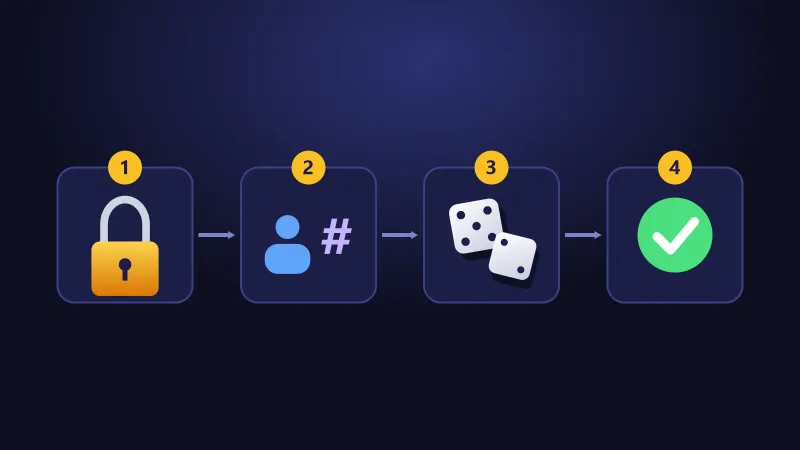
What are the four steps of a provably fair bet?
- The server seed is hashed. The casino generates a secret seed and shows you only its hash. This is the commitment.
- You add a client seed and a nonce. Your seed is yours to set. The nonce counts the bets made under this seed pair.
- The result is generated. The game combines server seed, client seed and nonce and turns the output into a dice roll, a card order or a crash point, depending on the game.
- The seed is revealed and checked. The casino shows the original server seed. You hash it, compare it with the fingerprint from step 1, and rerun the calculation.
Step 1 is the one that matters most. Because the hash was published before your bet, the casino had to settle on its secret before it knew what you would do.
Why does revealing the seed afterwards prove anything?
It works because a hash is a one-way commitment. If the casino had swapped its seed after seeing your bet, the swapped seed would produce a different hash, and the mismatch would show up immediately. Finding a different seed that produces the same hash is not something anyone can do in practice with a standard hash function such as SHA-256.
The client seed closes the other gap. If only the casino chose the randomness, you would have to trust it had not rigged the choice before hashing. Because your seed also goes into the calculation, the casino cannot know the final result when it commits.
On most provably fair sites the server seed is only revealed once you rotate it, meaning the casino retires it and starts a new one. Until then, only its hash is visible. That is why you check old bets, not the one in progress.
A worked example: how Duel does it
According to Duel's provably fair page, all of its house games are provably fair. Before each round, those games use a server seed, a client seed and a nonce, exactly the three values above.
Here is what Duel says happens, in order:
- Duel sends you the hex-encoded SHA-256 hash of the server seed before you bet, so it can't change the seed afterwards.
- The result comes from combining the server seed, the client seed and the nonce. Duel notes that letting players set their own client seed gives them a direct effect on the outcome.
- After the game, Duel reveals the unhashed server seed.
With the revealed seed in hand, Duel says you can check three things: that the server seed matches the original hash, that the combined seeds give the exact result you played, and that no one, Duel included, could have interfered.
We have not listed game-specific formulas here. Each Duel game turns the seeds into a result in its own way, and we did not check those against duel.com for this article. For the games themselves, see our guide to Duel Originals. Duel's provably fair page also links to an economics changelog covering bet limits and edge changes, which is a separate topic from fairness of the roll.
How do you verify a bet yourself?
You need the revealed server seed, the hash you were shown earlier, your client seed and the nonce of the bet. The steps are the same on any provably fair site:
- Before you play, copy the hash of the current server seed and note your client seed.
- Play your bets. Note the nonce of any bet you may want to check.
- Rotate the seed so the casino reveals the old server seed.
- Hash the revealed server seed. Compare it with the hash you copied in step 1. They must match exactly.
- Enter the server seed, client seed and nonce into a verifier and rerun the game's calculation.
- Compare the output with the result you actually got. If it is the same, that bet was generated from the committed seeds.
The DuelFree verifier is built for the last steps on Duel bets. We have not written out its input fields here, so follow the labels on the tool itself.
What does provably fair prove, and what doesn't it?
It proves that a given result came from the committed seeds and was not edited. It says nothing about whether the odds of the game are good for you. A provably fair game can still have a house edge, and most do.
| Provably fair does show | Provably fair does not show |
|---|---|
| The server seed was fixed before your bet | That the game's payouts or odds are generous |
| The revealed seed matches the published hash | That the house edge or RTP is low |
| The seeds and nonce reproduce your exact result | That you will win, or lose less, over time |
| The casino did not change one bet after seeing it | That the casino is licensed, solvent or pays withdrawals |
| Your own seed influenced the outcome | That limits, bonus terms or edge settings stay unchanged |
The edge is a separate number set by the game's payout table. Our house edge simulator shows what a given edge does to a bankroll over many bets. For the question of whether the operator itself is trustworthy, read Is Duel legit?, because a verified roll does not tell you how a casino treats withdrawals or accounts.
Can a provably fair predictor or hack work?
Not by the logic of the system. At the time you bet, the server seed is secret and only its hash is public. To predict a result in advance, a tool would need the server seed, which means reversing the hash. That is not feasible with a standard hash function.
What you can see before a bet is your own client seed, the nonce and the hash. None of them is enough to calculate the result. After the round the server seed is revealed, but by then the result is already known, so you are only verifying, not predicting.
We name no specific tools and make no claim about how any of them behave. We are only describing what the design allows. Anything that promises to forecast the next result of a provably fair game without the server seed is claiming something the commitment is built to rule out. Treat such offers as a red flag, particularly if they ask for money, your login or a download.
What are the limits of provably fair?
Two limits are worth knowing:
- You have to actually check. The system gives you the ability to verify. If nobody verifies, it protects no one. Checking a handful of bets after rotating a seed is the practical habit.
- Fair randomness is not a safe bet. A fair roll can still lose money, and no betting system beats the math over the long run.
If gambling stops being a game, our responsible gambling page lists limits, warning signs and where to get free help. Gambling is for adults only (18+).
FAQ
Is provably fair the same as a licensed casino?
No. A licence is about who operates the site and under what rules. Provably fair is about whether individual results can be verified. They answer different questions, and neither one replaces the other.
Does provably fair lower the house edge?
No. It shows the result was not altered. The house edge is set by the game's payouts, so a provably fair game can still carry a house edge.
Why does the casino show a hash and not the seed?
The hash commits the casino to the seed without revealing it. If the seed were visible during play, you could calculate results in advance. Revealing it afterwards lets you confirm nothing changed.
Should I change my client seed?
You can. Duel says setting your own client seed gives you a direct effect on the outcome. It does not improve your odds; it only means you contributed to the randomness.
Where do I check a Duel bet?
Use the provably fair verifier on DuelFree, with the seeds and nonce for the bet you want to check.
Duel facts in this article were checked against duel.com on 21 November 2026.