English
 Deutsch
 Français
 Norsk
 Suomi
 日本語
 Português
 Русский
 Čeština
 Ελληνικά
 हिन्दी
 ภาษาไทย
 中文
 Italiano
 Türkçe
 العربية
 עברית
 فارسی
 Español
 Nederlands
 Português (BR)
 Polski
 Svenska
 Bahasa Indonesia
 Tiếng Việt
 한국어
Short answer: basic strategy is the mathematically best play for every blackjack hand, based on your cards and the dealer’s face-up card. Follow the chart below and the house edge drops to roughly 0.5% under common rules, lower than almost any other casino game.
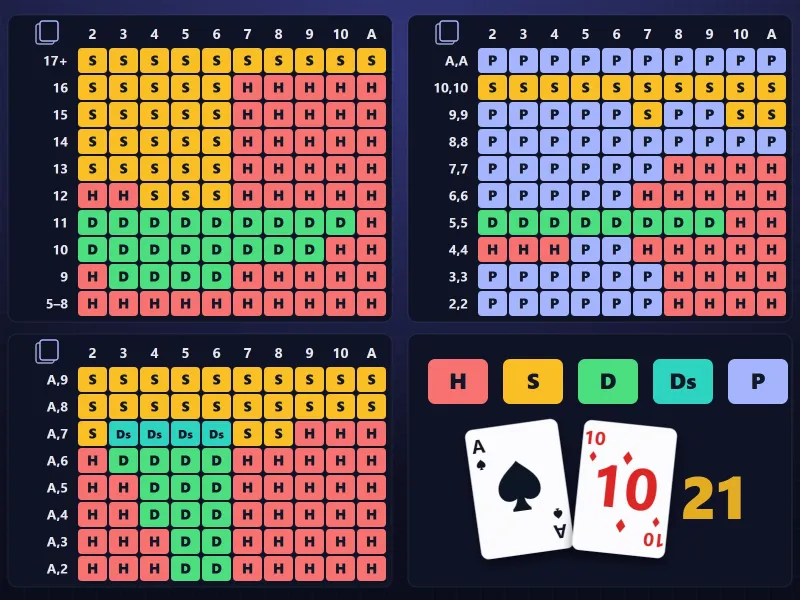
The chart is for the most common online rules: 4–8 decks, the dealer stands on soft 17, you may double on any two cards and after a split, and there is no surrender. Different rules change only a few cells, which we list further down.
How to read the chart
Find your hand on the left and the dealer’s face-up card at the top. The letter where they meet is your play:
- H: hit (take another card)
- S: stand (take no more cards)
- D: double down if allowed, otherwise hit
- Ds: double down if allowed, otherwise stand
- P: split the pair
A means ace, and 10 stands for any ten-value card (10, J, Q or K).
Hard totals
A hard hand has no ace, or an ace that can only count as 1.
| Your hand | 2 | 3 | 4 | 5 | 6 | 7 | 8 | 9 | 10 | A |
|---|---|---|---|---|---|---|---|---|---|---|
| 17–21 | S | S | S | S | S | S | S | S | S | S |
| 13–16 | S | S | S | S | S | H | H | H | H | H |
| 12 | H | H | S | S | S | H | H | H | H | H |
| 11 | D | D | D | D | D | D | D | D | D | H |
| 10 | D | D | D | D | D | D | D | D | H | H |
| 9 | H | D | D | D | D | H | H | H | H | H |
| 5–8 | H | H | H | H | H | H | H | H | H | H |
Soft totals
A soft hand contains an ace counted as 11. One more card cannot bust it, which is why you can double more often.
| Your hand | 2 | 3 | 4 | 5 | 6 | 7 | 8 | 9 | 10 | A |
|---|---|---|---|---|---|---|---|---|---|---|
| A,8–A,9 (soft 19–20) | S | S | S | S | S | S | S | S | S | S |
| A,7 (soft 18) | S | Ds | Ds | Ds | Ds | S | S | H | H | H |
| A,6 (soft 17) | H | D | D | D | D | H | H | H | H | H |
| A,4–A,5 (soft 15–16) | H | H | D | D | D | H | H | H | H | H |
| A,2–A,3 (soft 13–14) | H | H | H | D | D | H | H | H | H | H |
Pairs
With a pair, the first question is whether to split. If the chart does not say P, play the hand as a hard total (a pair of fives is a hard 10).
| Your pair | 2 | 3 | 4 | 5 | 6 | 7 | 8 | 9 | 10 | A |
|---|---|---|---|---|---|---|---|---|---|---|
| A,A | P | P | P | P | P | P | P | P | P | P |
| 10,10 | S | S | S | S | S | S | S | S | S | S |
| 9,9 | P | P | P | P | P | S | P | P | S | S |
| 8,8 | P | P | P | P | P | P | P | P | P | P |
| 7,7 | P | P | P | P | P | P | H | H | H | H |
| 6,6 | P | P | P | P | P | H | H | H | H | H |
| 5,5 | D | D | D | D | D | D | D | D | H | H |
| 4,4 | H | H | H | P | P | H | H | H | H | H |
| 2,2–3,3 | P | P | P | P | P | P | H | H | H | H |
The rules worth memorising
If you cannot keep the chart open, these rules cover most of its value:
- Always split aces and eights. Never split tens or fives.
- Double 11 against every dealer card except an ace, and double 10 against 2–9.
- Stand on hard 17 or more. Hit hard 8 or less.
- With hard 13–16, stand against a dealer 2–6 and hit against 7 or higher. With hard 12, stand only against 4–6.
- Never take insurance or even money. It is a side bet with a much higher edge.
Why basic strategy works
The dealer has no choices: they must draw to 16 and stand on 17. When the dealer shows a 2–6, they are more likely to bust, so you stand on weak totals and let them take the risk. When the dealer shows 7 or higher, a strong total is likely, so you keep drawing. Basic strategy comes from computer simulations of every possible hand. It is not a hunch, and it cannot be improved without knowing which cards are left in the deck.
That is also why card counting does not work in online blackjack: RNG games such as Duel Blackjack shuffle a fresh deck for every hand, so there is nothing to count. On Duel the shuffle is also provably fair, so you can check afterwards that the cards were not changed after you placed your bet.
Rule changes that affect the chart
- Dealer hits soft 17: double 11 against an ace, A,8 against a 6 and A,7 against a 2 (stand if you cannot double). The house edge rises by about 0.2%.
- No double after split: do not split 4,4; split 2,2 and 3,3 only against 4–7, and 6,6 only against 3–6.
- Surrender allowed: surrender hard 16 against 9, 10 or an ace, and hard 15 against a 10.
- Blackjack pays 6:5 instead of 3:2: the house edge rises by about 1.4%. Avoid these tables.
How low does the house edge go?
With perfect basic strategy under the rules above, the house edge is about 0.4–0.5%. Typical player mistakes push it to 2% or more. On Duel you can lower your effective edge further with rakeback, which returns part of the edge on every hand. The rakeback calculator shows what it is worth at your stakes, and our Duel bonus guide explains how it is paid.
Ready to practise? Play blackjack at Duel with the code DUELFREE, keep this chart open and follow it hand by hand.
FAQ
Does basic strategy guarantee a win?
No. It is the best possible play, but the house keeps a small edge, and short-term results swing a lot. It makes your money last longer. It does not make blackjack profitable.
Should I ever take insurance?
No. Insurance is a side bet that the dealer has blackjack, and it carries a house edge of about 7% in a six-deck game. Basic strategy never takes it.
Why split eights against an ace?
16 is the worst hand in blackjack. Two hands that start with an 8 lose less on average than one hand of 16, even against an ace.
Can I use this chart for live dealer blackjack?
Yes, as long as the table rules match. Check whether the dealer hits soft 17 and whether you can double after a split, then adjust the few cells listed above.
Gambling is entertainment, not a way to make money. Play only with money you can afford to lose, and visit our responsible gambling page if it stops being fun. 18+ only.