 English
 Deutsch
 Français
 Norsk
 Suomi
 日本語
 Português
 Русский
 Čeština
 Ελληνικά
 हिन्दी
 ภาษาไทย
 中文
 Italiano
 Türkçe
 العربية
 עברית
 فارسی
 Español
 Nederlands
 Português (BR)
 Polski
 Svenska
 Bahasa Indonesia
 Tiếng Việt
 한국어

Disclosure: DuelFree is an independent guide, not run by Duel. We may earn a commission if you sign up through links on this page; it doesn't change how we cover anything. 18+ only.
Duel runs two leaderboards, a $3,000,000 monthly and a $25,000 daily, according to Duel. Points are proportional to the net house edge you pay, so zero-edge bets earn nothing. The prizes are top-heavy: first place takes 50% of each pool. Entering means paying house edge on purpose, which is a cost, not a bonus. We don't recommend chasing it.
What the Duel leaderboards pay
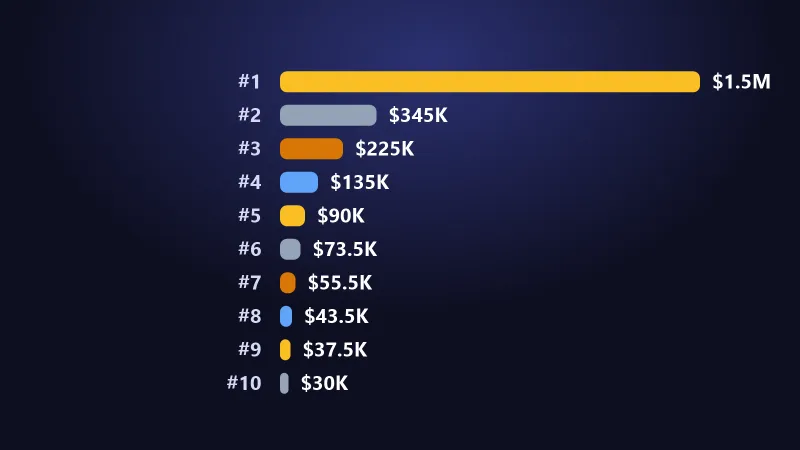
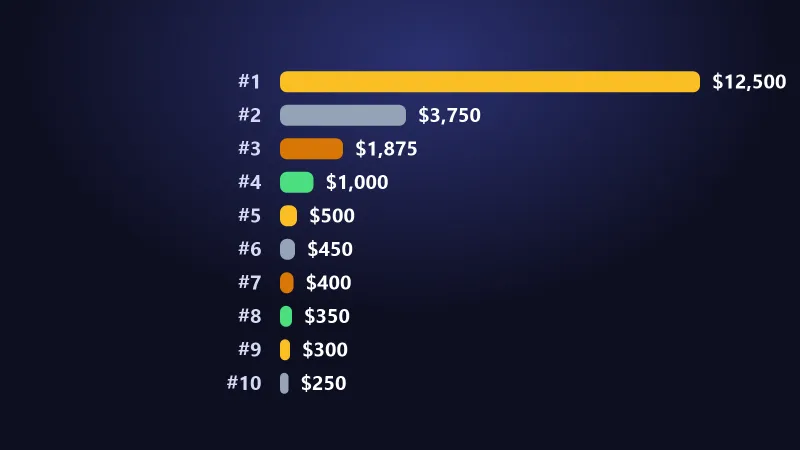
Duel's site banner reads: "$3m monthly and $25k daily leaderboards now live for slots, live games and originals post zero edge." Two boards, two pool sizes. Both pay a ranked list of prizes, and the biggest slice goes to first place.
The monthly prize pool is $3,000,000. The daily prize pool is $25,000. The monthly panel was checked on a game page on 21 November 2026 and the daily panel on 20 November 2026. Prize pools and payouts can change, so treat the numbers below as a snapshot, not a promise.
Prize per place, 1st to 10th
Here are the top 10 prizes shown in each panel. The "share" columns are our own arithmetic: the prize divided by the pool.
| Place | Monthly prize | Monthly share | Daily prize | Daily share |
|---|---|---|---|---|
| 1st | $1,500,000 | 50.0% | $12,500 | 50.0% |
| 2nd | $345,000 | 11.5% | $3,750 | 15.0% |
| 3rd | $225,000 | 7.5% | $1,875 | 7.5% |
| 4th | $135,000 | 4.5% | $1,000 | 4.0% |
| 5th | $90,000 | 3.0% | $500 | 2.0% |
| 6th | $73,500 | 2.45% | $450 | 1.8% |
| 7th | $55,500 | 1.85% | $400 | 1.6% |
| 8th | $43,500 | 1.45% | $350 | 1.4% |
| 9th | $37,500 | 1.25% | $300 | 1.2% |
| 10th | $30,000 | 1.0% | $250 | 1.0% |
| Top 10 total | $2,535,000 | 84.5% | $21,375 | 85.5% |
The panels continue past 10th place. We don't state how many places are paid, because we haven't confirmed that. Check the panel itself.
How top-heavy the prizes are
Very. First place gets half of each pool: $1,500,000 of $3,000,000 monthly and $12,500 of $25,000 daily. The top 10 together take $2,535,000 (84.5%) of the monthly pool and $21,375 (85.5%) of the daily pool.
That leaves at most $465,000 of the monthly pool and $3,625 of the daily pool for every place below 10th, whatever the number of paid places turns out to be. The gaps between places are steep too. Monthly first place is about 4.3 times second place, and 50 times tenth. On the daily board, first is 3.3 times second and also 50 times tenth.
The practical reading: the prize money is concentrated in a handful of places. The expected cost of climbing is paid by everyone who plays toward it, while the large prizes go to very few.
How points are earned: net house edge paid
According to Duel's economics changelog (leaderboard update of 1 November 2026), points are proportional to the net house edge paid. Net house edge means the edge after rakeback. Points start only once net house edge is paid.
Duel gives its own example: an external game with a 1.5% net edge earns 10 times the points of an Original at a 0.15% net edge, for the same wager. The same update says Originals now earn leaderboard points for both dailies and monthlies.
Our reading of that rule: points track the expected cost you pay, not the volume you wager. Wagering is only the vehicle. If you want to see how rakeback shrinks the edge you actually pay, our Duel rakeback calculator and the house edge simulator show the numbers.
What it costs: an illustrative example
This is our own illustration, not a Duel figure and not a prediction. To earn points you pay net house edge, and the expected cost of that edge is simple to compute.
- Wager $100,000 at a 1.5% net edge: expected cost is $1,500.
- Wager $100,000 at a 0.15% net edge: expected cost is $150.
Points scale with that cost. The first case earns 10 times the points of the second, and costs 10 times as much in expectation. Expected cost is an average. Your real result on any run can be far better or far worse, but the average is what the edge charges you over time.
What this example can't tell you is what a rank costs. Your position depends on what everyone else pays that day or month, and you can't see that in advance. Nothing here implies you are likely to place, or to win back what you spend.
Why zero-edge bets don't count
If points are proportional to the net house edge paid, a bet with no edge pays none and earns zero. That is how Duel's changelog describes it: zero-edge bets earn no points, with one exception, Blackjack mistakes. Video Poker mistakes earn no extra points.
This matters because Duel advertises zero-edge play on some games, within certain modes and limits. Our guide to zero house edge covers where it applies and its limits, and the Duel Originals guide covers the games themselves. The banner wording "originals post zero edge" points the same way: once an Original is at zero edge, it stops earning leaderboard points.
The trade is plain. The cheapest way to play on Duel is also the way that earns nothing on the board.
Chasing a leaderboard means paying house edge on purpose
The cost side is certain in expectation. The benefit side is a single, narrow prize that most entrants won't reach.
- Cost: every point comes from edge you pay. Higher-edge games earn points faster, and also cost more per dollar wagered.
- Benefit: a prize only if you rank high enough, and the steep curve above means ranks outside the top handful pay little compared with first.
- Uncertainty: you don't control how much other people play.
- Referral side effect: Duel's referral FAQ says leaderboard prizes are deducted from referral income. If you refer people, a prize reduces that income.
Don't chase leaderboards. Raising stakes or switching to higher-edge games to climb a ranking is how a small, controlled budget turns into a large loss. If you play at all, set a limit before you start and keep it, whatever the board shows. Our responsible gambling page covers limits, warning signs and free help. Gambling is 18+ only, and losses are the normal outcome.
If you play on Duel anyway
Decide first whether you want rakeback and low edge, or leaderboard points. They pull in opposite directions. If your goal is the lowest expected cost, the zero-edge route gives that up on purpose. Our DUELFREE code page explains the sign-up offer and its conditions, which we mark where we haven't verified them.
If you ever do take part in a race, treat the leaderboard as a side effect of a budget you were already comfortable losing, never as a reason to raise it.
Duel leaderboard FAQ
Do zero-edge bets earn leaderboard points?
No, according to Duel's changelog. Zero-edge bets earn no points, except Blackjack mistakes. Video Poker mistakes earn no extra points.
Do Duel Originals count?
Yes, since the leaderboard update on 1 November 2026, Originals earn points for dailies and monthlies. Points are proportional to the net house edge paid, so a 0.15% net-edge Original earns one tenth of the points of a 1.5% net-edge game for the same wager.
How many places are paid?
We don't know. The panels list at least the top 10 and continue beyond them. The count of paid places is not something we have confirmed, so check the panel.
When do the boards reset?
Duel's leaderboard panel shows a live countdown to the end of the current daily and monthly race, so check the panel for exact timing.
Is chasing the leaderboard worth it?
We say no. Points come from paying house edge, the prizes are concentrated in a few places, and you can't see what other players will pay. If you play, play within a limit you set beforehand.
Duel facts in this article were checked against duel.com on 21 November 2026.