 English
 Deutsch
 Français
 Norsk
 Suomi
 日本語
 Português
 Русский
 Čeština
 Ελληνικά
 हिन्दी
 ภาษาไทย
 中文
 Italiano
 Türkçe
 العربية
 עברית
 فارسی
 Español
 Nederlands
 Português (BR)
 Polski
 Svenska
 Bahasa Indonesia
 Tiếng Việt
 한국어

Disclosure: DuelFree is an independent guide, not run by Duel. We may earn a commission if you sign up through links on this page; it doesn't change how we cover anything. 18+ only.
House edge is the share of each bet a casino expects to keep over time. Return to player (RTP) is its mirror image: RTP = 100% minus house edge. European single-zero roulette has a 2.70% edge, so every $1,000 you wager costs about $27 on average. The formula is expected loss = amount wagered x house edge, and you can test it in our house edge simulator.
- House edge is a price paid on every bet, not only on losing ones.
- The cost scales with total money wagered, so volume matters more than any single bet.
- Variance decides what happens in a short session. Edge decides the average over a long one.
- Rakeback and bonuses lower your net edge only by the amount they actually return.
What is house edge, and how does it relate to RTP?
House edge is the percentage of your wagers the casino expects to keep in the long run. At a 2% edge, the casino expects to keep $2 of every $100 wagered. The other $98 comes back to players on average, which is the RTP: 98%.
The two numbers always add to 100%. A game labelled 97.30% RTP has a 2.70% house edge, and a game with a 0.10% edge has a 99.90% RTP. If you see one, you can work out the other in your head.
Two words in that definition do the work. "Expected" means an average over a very large number of bets, not a promise about your next ten. "Wagered" means the total you stake, not the amount you deposit. We come back to both below.
How do you calculate house edge? A roulette example
To calculate house edge, work out the average result of one bet: multiply each outcome by its probability, then add them up. The edge is the average loss as a share of the stake. Roulette is the cleanest example because every probability is known.
Take a $1 straight-up bet (one number) on European single-zero roulette. The wheel has 37 pockets and the bet pays 35 to 1.
- You win with probability 1/37 and gain $35.
- You lose with probability 36/37 and lose $1.
- Average result = (1/37 x 35) - (36/37 x 1) = (35 - 36) / 37 = -1/37 = -$0.027.
The house edge is 1/37, or about 2.70%. The RTP is 97.30%.
Now the American double-zero wheel. It has 38 pockets, and the same bet still pays 35 to 1. The average result is (35 - 37) / 38 = -2/38, which is about -5.26%. The payout never changed. The extra zero pocket took the player's odds down and doubled the edge.
The same method works on any bet with known odds: payout multiplied by win probability, minus the stake. It does not require guessing. It only requires the real probabilities, which is why we don't quote an edge for any game whose rules or paytable we haven't seen.
Expected loss = amount wagered x house edge
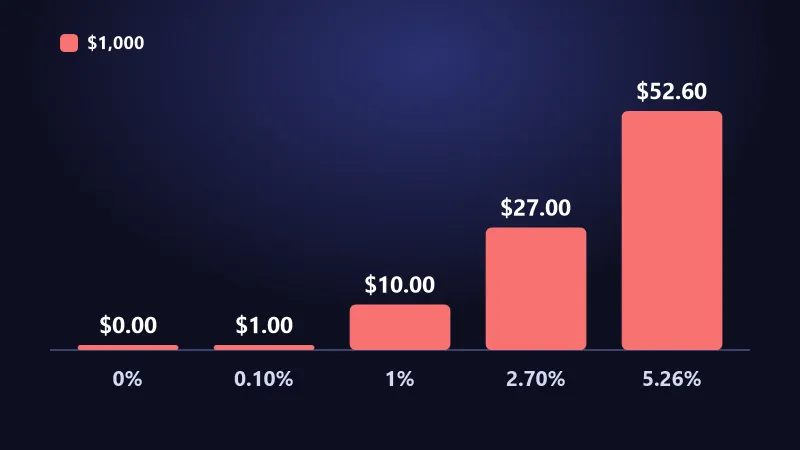
Expected loss is the house edge applied to everything you wager. Wager $1,000 at a 1% edge and the expected loss is $10. Wager $1,000 at 5.26% and it is $52.60. This is our own arithmetic, using the edge percentages as inputs.
| House edge | RTP | Expected loss per $1,000 wagered |
|---|---|---|
| 0% | 100% | $0 |
| 0.10% | 99.90% | $1 |
| 1% | 99% | $10 |
| 2.70% (European roulette) | 97.30% | $27 |
| 5.26% (American roulette) | 94.74% | $52.60 |
A useful check: the 2.70% row is the roulette example above. Put $1 on one number for 37 spins and you stake $37 in total. The expected loss is $37 x 1/37 = $1, which is one chip lost on average out of 37 staked.
Why house edge compounds with volume
The edge is charged on every unit you wager, so it grows with the number of bets and with their size. A small edge looks harmless on one spin and large across a long session. Re-betting your winnings counts as wagering again, which is why total wagered ends up far above the bankroll you started with.
Here is the effect with our arithmetic. Start with $1,000 and put your whole balance on a 2.70% edge bet, then do it again with whatever is left, ten times in a row. Your expected balance is $1,000 x 0.973 multiplied ten times (0.973 to the power of 10), which is about $760. A 2.70% edge on each bet took roughly 24% of the bankroll by the tenth round, in expectation.
Two practical consequences follow:
- Fast games cost more per hour. If you place 600 bets an hour instead of 60, the edge is charged ten times as often.
- Lower edge beats cleverer betting. A system changes the pattern of wins and losses. It does not change the edge on each unit wagered. Our posts on roulette strategy and the Martingale system show the same arithmetic applied to betting systems that look safer than they are.
House edge vs variance: why short sessions don't follow the math
Edge is the average cost. Variance is how far real results swing around that average. Over a few dozen bets, variance dominates and the edge is barely visible.
Go back to the $1 straight-up bet on European roulette over 37 spins. The expected result is -$1. But the chance of hitting your number at least once in 37 spins is 1 minus (36/37 multiplied by itself 37 times), about 64%. About 36% of the time you hit nothing and are down $37. When you do hit once, you finish $1 down. Hit twice and you are $35 up. Almost none of those outcomes equals the "expected" -$1.
That is why a short winning run says nothing about whether a game's edge is high or low. It also works the other way: a lower edge doesn't stop a bad night. Our zero house edge explainer covers the extreme case, where the edge is gone and the swings remain.
The reverse mistake is expecting a loss to be "due" a win. Each spin is independent, and the wheel has no memory. Variance evens out only in the sense that the average per bet approaches the edge as bets pile up, not that earlier losses get paid back.
How do bonuses and rakeback change the net edge?
Net edge is the house edge minus whatever the casino returns to you through rakeback or a bonus. If a game has a 3.5% edge and returns half of it, you pay a 1.75% net edge. That is the example Duel gives on its "Why Bonuses Suck" page, which says net edge is the number that matters.
Apply the same formula to the net figure. On $10,000 wagered, a 3.5% edge costs $350 in expectation. After 50% comes back, the net cost is $175. Rakeback cuts the price of play, and it does not turn the game into a profitable one.
Three checks make a bonus comparable to a plain edge:
- What does it return, and on what? A percentage of wagers, of losses, or of the edge are three different things. Convert the offer into a percentage of total wagered.
- Is there a wagering requirement? A bonus you must wager many times before withdrawing adds its own expected loss, which can cancel the benefit.
- Which games does it cover? A return that applies to one game type tells you nothing about the others.
To see what a rakeback rate does to your own volume, use our rakeback calculator, then run the net figure through the house edge simulator to see a session at that edge.
What low edges look like at Duel
According to Duel, its Originals are labelled "100% RTP" and offer a Zero Edge option within limits. Duel also says Blackjack's edge scales with bet size, from 0.10% for base bets up to $45,748 to 0.57% at the maximum base bet of $260,608. At those figures, expected loss per $1,000 wagered is $1 and $5.70.
Those edges apply to the bet setting, not to your decisions. In Blackjack a wrong play still costs expected value on top of the edge, which is why our Duel Blackjack guide and basic strategy chart matter. For the games themselves, see our guide to Duel Originals.
A low edge is a lower price, not safety. The formula above still applies: at any edge, the more you wager, the more you are expected to pay, and variance can hand you a loss at any edge.
House edge FAQ
Is house edge the same as RTP?
No, but they are linked. RTP = 100% minus house edge. A 2.70% edge means a 97.30% RTP. One is what the casino keeps on average and the other is what returns to players on average.
Does a lower house edge mean I will win?
No. A lower edge means a lower expected cost per dollar wagered. Results over a short session are driven by variance, so you can lose at 0.10% and win at 5.26%. The edge only shows up reliably over a large number of bets.
How do I work out how much I will lose?
Multiply the total amount wagered by the house edge. Wagering $5,000 at a 2.70% edge gives an expected loss of $135. Total wagered counts every bet, including re-bets of winnings. This is an average, and a single session can land well above or below it.
Why is American roulette worse than European roulette?
American roulette adds a second zero pocket, 38 pockets in total, while payouts stay the same. That moves the edge from 1/37 (2.70%) to 2/38 (5.26%).
Can a betting system beat the house edge?
No. A system changes how wins and losses are arranged, not the edge on each unit wagered. Our Martingale post works through why doubling after a loss does not change the expected cost.
Try the numbers yourself
Our house edge simulator runs a session at different edges, so you can compare a 2.70% edge with 0.10% and see how far a real run drifts from the expected loss. Set a loss limit before you play, and treat the expected loss as the price of the entertainment.
18+ only. Check that online gambling is legal where you live. If gambling stops being fun, our responsible gambling page lists limits, warning signs and free help.
Duel facts in this article were checked against duel.com on 21 November 2026.