 English
 Deutsch
 Français
 Norsk
 Suomi
 日本語
 Português
 Русский
 Čeština
 Ελληνικά
 हिन्दी
 ภาษาไทย
 中文
 Italiano
 Türkçe
 العربية
 עברית
 فارسی
 Español
 Nederlands
 Português (BR)
 Polski
 Svenska
 Bahasa Indonesia
 Tiếng Việt
 한국어
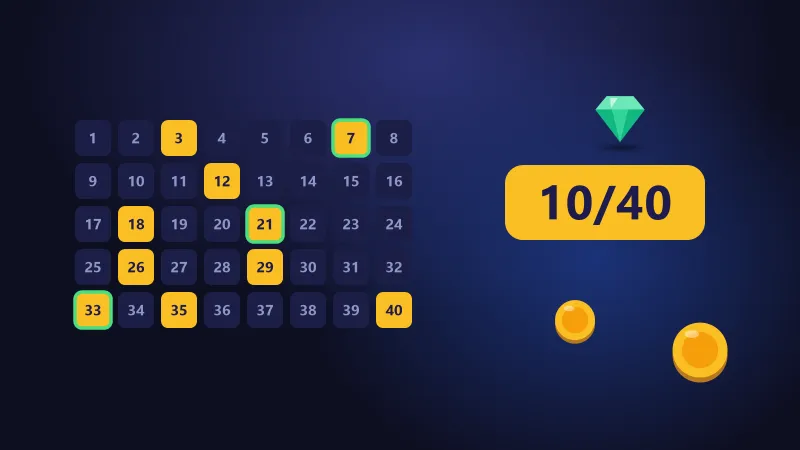
Disclosure: DuelFree is an independent guide, not run by Duel. We may earn a commission if you sign up through links on this page; it doesn't change how we cover anything. 18+ only.
Duel Keno draws 10 numbers from 40, and you pick between 1 and 10 of them. You are paid by how many of your picks are drawn, using a pay table that depends on the risk level: Classic, Low, Medium or High. By our calculation, every pay table the panel showed returns between 99.79% and 100.00% over the long run. Risk changes how often and how much you are paid, not the long-run cost. No number choice or betting pattern changes that.
- 10 of 40 numbers are drawn each round. Every number has the same 25% chance of being drawn.
- RTP of the 40 tables (4 risk levels × 1–10 picks): 99.79% to 100.00%, our calculation. All 1-pick tables are exactly 100.00%.
- With 10 picks, the chance of any payout is Low 79.6%, Classic 48.5%, Medium 48.5% and High 19.7%.
- "Best numbers", "hot numbers" and "cold numbers" don't exist. Autopick is as good as picking by hand.
How does Duel Keno work?
You pick numbers on a board, a draw follows, and matches decide the payout. Here is what Duel's Keno panel shows, as we saw it logged out on 21 November 2026.
- Manual and Auto tabs. Manual is one bet per click. Auto places bets for you.
- Bet Amount. A field with ½, 2x and MAX buttons.
- Risk. Classic, Low, Medium or High. Each has its own pay table.
- The board. The numbers 1–40. You pick 1 to 10 of them. Autopick fills the picks for you and Clear Table empties the board.
- Zero Edge, Hotkeys and Provably Fair.
The draw rule comes from Duel's own provably fair verification code for Keno: 10 numbers are drawn from 40 (drawnCount = 10, gridSize = 40). The draw is a Fisher-Yates shuffle driven by an HMAC-SHA256 of the server seed, client seed and nonce. Keno is one of Duel's Originals, its in-house games. For the others, see our guide to Duel Originals, and for a sibling game with a single target, our Duel Limbo guide.
One note on every pay table in this article. We read them on duel.com/keno logged out, with no bet placed, at the panel's default settings, so they are the standard-mode tables. We did not read any Zero Edge tables. The panel can differ for your stake or mode, so check the table it shows for your bet before you rely on ours.
How many of your numbers will be drawn?
Usually two or three. Ten numbers come from 40, so a pick is drawn 25% of the time, and with 10 picks you expect 2.5 hits on average. These are our figures from the hypergeometric distribution: the chance of exactly k hits with n picks is C(n,k) × C(40−n,10−k) ÷ C(40,10).
| Hits (10 picks) | Chance |
|---|---|
| 0 | 3.54% |
| 1 | 16.88% |
| 2 | 31.07% |
| 3 | 28.82% |
| 4 | 14.71% |
| 5 | 4.24% |
| 6 | 0.68% |
| 7 or more | about 0.06% |
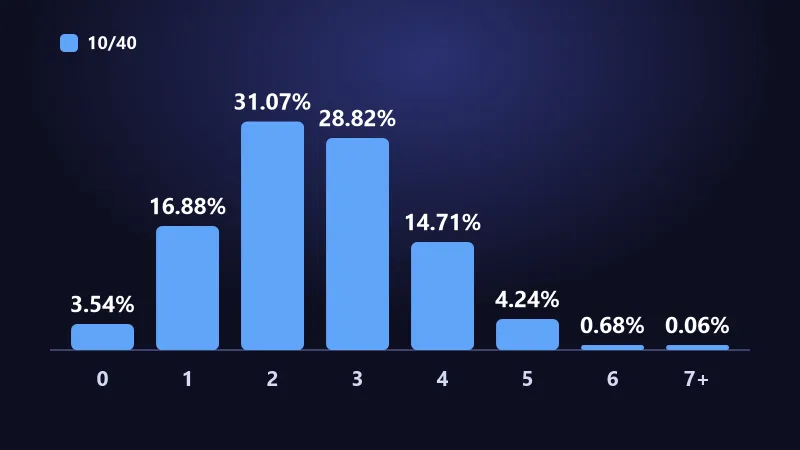
Hitting all 10 has a chance of 1 in C(40,10), which is about 1 in 848 million. Almost 60% of rounds end with 2 or 3 hits, and at those counts the 10-pick tables below pay between 0x and 1.61x.
What do the Duel Keno pay tables pay with 10 picks?
Pick 10 numbers and the four risk levels pay very differently for the same hits. Multipliers are what the panel showed (see the note above). The last two rows are our calculation from these multipliers and the hit chances.
| Hits | Classic | Low | Medium | High |
|---|---|---|---|---|
| 0 | 0x | 0x | 0x | 0x |
| 1 | 0x | 0x | 0x | 0x |
| 2 | 0x | 1.11x | 0x | 0x |
| 3 | 1.40x | 1.22x | 1.61x | 0x |
| 4 | 2.27x | 1.31x | 2.01x | 3.51x |
| 5 | 4.60x | 1.81x | 4.10x | 8.10x |
| 6 | 8.20x | 3.60x | 7.10x | 13.10x |
| 7 | 18x | 14x | 27x | 64x |
| 8 | 55x | 60x | 110x | 600x |
| 9 | 100x | 300x | 600x | 1000x |
| 10 | 200x | 1200x | 1200x | 1200x |
| RTP (our calculation) | 99.96% | 99.99% | 99.99% | 99.94% |
| Chance of any payout | 48.5% | 79.6% | 48.5% | 19.7% |
Every nonzero payout at 10 picks is above 1x, so here "any payout" and "a profitable round" are the same thing. They are not the same at every pick count, as the next section shows.
What are the RTP and payout chance for every risk level and pick count?
RTP is the share of your stake returned on average, and it barely moves between tables. We computed it as the sum of each payout times its hit chance. Each cell below reads "RTP / chance of any payout".
| Picks | Classic | Low | Medium | High |
|---|---|---|---|---|
| 1 | 100.00% / 25.0% | 100.00% / 100.0% | 100.00% / 100.0% | 100.00% / 25.0% |
| 2 | 99.92% / 44.2% | 99.88% / 44.2% | 99.92% / 44.2% | 99.92% / 5.8% |
| 3 | 99.90% / 58.9% | 99.90% / 58.9% | 99.90% / 14.9% | 99.90% / 1.2% |
| 4 | 99.89% / 70.0% | 99.89% / 25.6% | 99.89% / 25.6% | 99.92% / 4.2% |
| 5 | 99.90% / 78.3% | 99.88% / 36.7% | 99.91% / 36.7% | 99.91% / 8.9% |
| 6 | 99.87% / 47.4% | 99.95% / 47.4% | 99.95% / 15.3% | 99.90% / 2.6% |
| 7 | 99.88% / 57.2% | 99.90% / 57.2% | 99.89% / 22.8% | 99.89% / 5.2% |
| 8 | 99.90% / 31.2% | 99.84% / 65.9% | 99.94% / 31.2% | 99.93% / 8.9% |
| 9 | 99.88% / 39.9% | 99.79% / 73.4% | 99.94% / 39.9% | 99.93% / 13.8% |
| 10 | 99.96% / 48.5% | 99.99% / 79.6% | 99.99% / 48.5% | 99.94% / 19.7% |
Keep "any payout" and "profit" apart. Some payouts are below 1x, and those are still losses. On the Low table with 1 pick, 0 hits pays 0.71x, so the chance of any payout is 100% and you still lose 29% of the stake on that outcome. A 1-pick Low bet returns exactly 100.00% on average only because the 1.87x on a hit pays for it.
What do the risk levels change?
They change the shape of your results, not the price. All four 10-pick tables sit within 0.05 percentage points of each other, from 99.94% to 99.99%, yet the chance of getting anything back runs from about 1 round in 5 to 4 in 5.
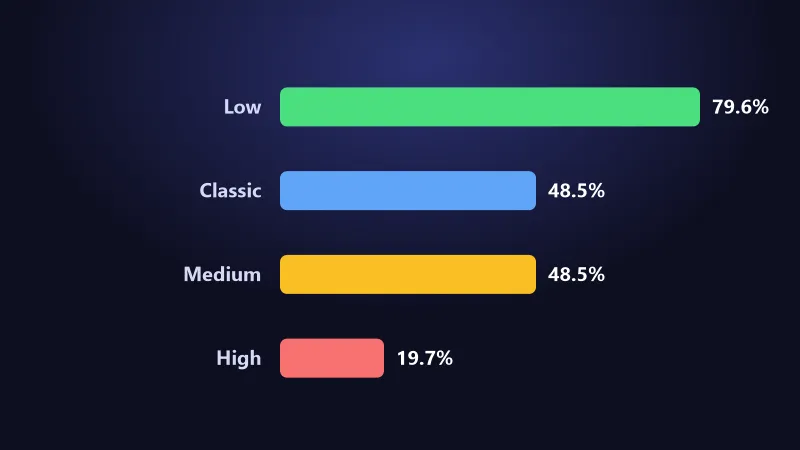
- Low pays on 2 or more hits, so it pays back in about 4 rounds out of 5. The cost is small payouts: 1.11x to 1.81x for 2 to 5 hits.
- Classic and Medium both pay on 3 or more hits (48.5%). Classic tops out at 200x, Medium at 1200x.
- High pays only from 4 hits, so about 4 rounds in 5 return nothing. In return, 5 hits pays 8.10x and 8 hits pays 600x.
At 10 picks the top multiplier is 200x on Classic and 1200x on the other three. It needs all 10 picks drawn, which is about a 1 in 848 million event. A table that pays 1200x for something that rare must take the money from somewhere, and it takes it from the common outcomes. That is why High loses most rounds.
The average cost is the same, so the difference is variance. Over thousands of rounds, High swings far more than Low around the same small average loss. Our house edge explainer covers why total wagered matters more than any one result, and the house edge simulator lets you run your own volume at the edges above.
Are there best Keno numbers or a strategy that works?
No. The draw does not care which numbers you pick. Every number has the same 10-in-40 (25%) chance to be drawn each round, so hot, cold and "due" numbers don't exist, and Autopick is no worse than choosing by hand. That follows from the draw rule, not from opinion. Past draws don't change the next one.
What you do control is the pick count and the risk level, and those decide variance. Fewer picks on Low gives frequent small returns. More picks on High gives rare large ones. Neither lowers the cost per unit wagered.
Betting patterns don't change the edge either. Auto mode places bets for you, and progressions such as doubling after a loss only change what you stake next. A loss streak is the normal case on High, where 80% of rounds pay nothing, and a progression needs its biggest stake right then. Our Martingale article works through that arithmetic.
How do you check a Keno draw is provably fair?
The panel has a Provably Fair link. Provably fair means each result can be checked afterwards with cryptographic seeds rather than taken on trust. Our provably fair explainer covers the idea in plain terms. Duel's Keno check uses the server seed, client seed and nonce to run the Fisher-Yates shuffle that produces the draw. To check a result yourself, open the Verify tab on Duel's Provably Fair page, choose Keno and enter your client seed, server seed and nonce. Our provably fair page explains the steps; its own verifier currently covers Blackjack only.
Verification proves a draw was generated as the seeds say. It does not tell you how good the pay table is for you. For that, use the RTP grid above.
Keno, Zero Edge and the leaderboards
Duel's Keno panel has a Zero Edge button, the same option Duel offers across its Originals. Our zero house edge explainer covers what it does and doesn't mean. We did not read Keno's Zero Edge tables, so we make no claim about them here. A zero edge would remove the expected cost, not the variance.
Duel awards leaderboard points in proportion to the net edge paid, and its economics changelog says zero-edge bets earn no points. So zero-edge Keno bets don't count toward the leaderboard. Standard-mode bets can earn points, but each one carries the cost shown in the tables. Our leaderboards guide has the pool sizes and how points work. Don't raise your volume to chase a place.
Responsible play
You must be 18 or older, and you should check that online gambling is legal where you live. The normal outcome of a Keno session is a loss, because the RTP is at or below 100% in every table we read, and the high-risk tables return nothing in most rounds. Decide a stake and a loss limit before you start, and stop when you reach either. If you want to try the game, you can sign up to Duel through our link. Never bet money you need, and never raise your stake or risk level to win back a loss. Our responsible gambling page lists limits, warning signs and free help.
Duel Keno FAQ
How many numbers are drawn in Duel Keno?
Ten numbers are drawn from 40. You pick between 1 and 10 numbers on the board, and your payout depends on how many of them are drawn.
What is the RTP of Duel Keno?
By our calculation, between 99.79% and 100.00% for the 40 pay tables the panel showed, and exactly 100.00% for every 1-pick table. Read the tables for your own bet on the panel, since we read them logged out at default settings.
Which Duel Keno risk level is best?
None is cheaper on average. Low pays something about 79.6% of the time with 10 picks and High about 19.7%, with very different top payouts. Pick the one whose swings you can stomach.
What are the best Keno numbers to pick?
There are none. Each number has the same 25% chance each round, and a draw doesn't depend on earlier draws.
Do zero-edge Keno bets earn leaderboard points?
No. Duel's economics changelog says zero-edge bets earn no leaderboard points.
Can I check a Keno result myself?
Yes. Open the Verify tab on Duel's Provably Fair page, choose Keno and enter your client seed, server seed and nonce.
Duel facts in this article were checked on duel.com on 21 November 2026.