 English
 Deutsch
 Français
 Norsk
 Suomi
 日本語
 Português
 Русский
 Čeština
 Ελληνικά
 हिन्दी
 ภาษาไทย
 中文
 Italiano
 Türkçe
 العربية
 עברית
 فارسی
 Español
 Nederlands
 Português (BR)
 Polski
 Svenska
 Bahasa Indonesia
 Tiếng Việt
 한국어
Disclosure: DuelFree is an independent guide, not run by Duel. We may earn a commission if you sign up through links on this page; it doesn't change how we cover anything. 18+ only.
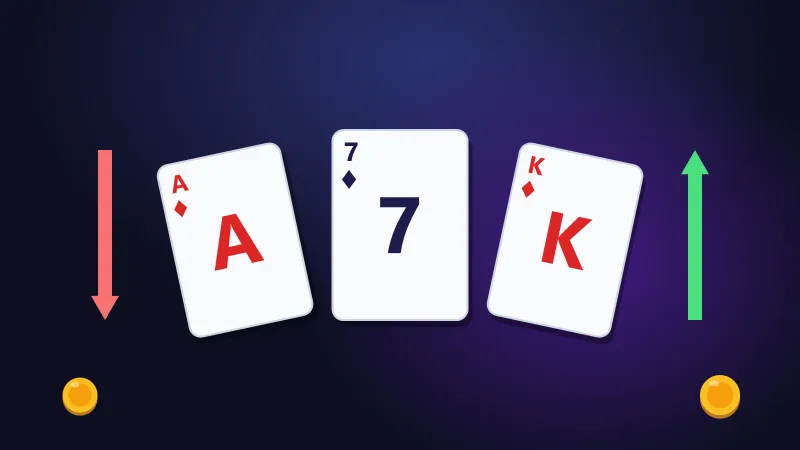
Hilo is one of Duel's Originals, its in-house games. You start from a card and guess whether the next one is higher or lower. According to Duel's rules, the more cards revealed, the higher the payout multiplier, and a wrong guess loses the bet. Duel draws every card from an "infinite deck", so past cards don't change the next one. The panel's multipliers fit 99.9% ÷ probability, a 0.1% edge per guess by our arithmetic.
- Ace is lowest, King is highest. On middle cards the same rank also wins, at a lower payout.
- Every card is an independent draw from a full 52-card deck, so card counting does nothing.
- Safe-looking guesses (92.31%) pay only 1.08x. Five in a row still fails about one round in three.
- Skip Card changes the card you face. It doesn't change the edge on your guess.
What are the rules of Duel Hilo?
Duel's Rules box lists six points, and we have paraphrased them in order.
- Unlimited decks. Cards are never used up.
- Higher or lower. You guess whether the next card is higher or lower than the current one. On middle cards, the same rank also wins, with a lower payout.
- Card order. Ace is the lowest card and King the highest.
- Ends of the range. On a King or an Ace, the choice is between "same" or lower/higher.
- Rising payout. The more cards revealed, the higher the payout multiplier.
- No cap. There is no maximum payout multiplier, only bet and profit limits.
Duel's rules don't give a formula for how the running multiplier builds from card to card, so we don't state one. The bet panel, as we saw it logged out on 21 November 2026, has a Bet Amount field with ½, 2x and MAX, two option buttons that each show a probability and a multiplier, Skip Card and Place Bet. Under them are Zero Edge, Hotkeys, Rules and Provably Fair. Read the limits shown there before you bet. For the other Originals, see our guide to Duel Originals.
What are the odds and multipliers for every card?
Each card has two options, and each option shows its own probability and multiplier. Probabilities are k/13, because the deck has 13 ranks and every draw is independent. The table is from the panel's standard mode.
| Current card | Option 1 | Option 2 |
|---|---|---|
| A | Same 7.69% → 12.98x | Higher 92.31% → 1.08x |
| 2 | Higher or Same 92.31% → 1.08x | Lower or Same 15.38% → 6.49x |
| 3 | Higher or Same 84.62% → 1.18x | Lower or Same 23.08% → 4.32x |
| 4 | Higher or Same 76.92% → 1.29x | Lower or Same 30.77% → 3.24x |
| 5 | Higher or Same 69.23% → 1.44x | Lower or Same 38.46% → 2.59x |
| 6 | Higher or Same 61.54% → 1.62x | Lower or Same 46.15% → 2.16x |
| 7 | Higher or Same 53.85% → 1.85x | Lower or Same 53.85% → 1.85x |
| 8 | Higher or Same 46.15% → 2.16x | Lower or Same 61.54% → 1.62x |
| 9 | Higher or Same 38.46% → 2.59x | Lower or Same 69.23% → 1.44x |
| 10 | Higher or Same 30.77% → 3.24x | Lower or Same 76.92% → 1.29x |
| J | Higher or Same 23.08% → 4.32x | Lower or Same 84.62% → 1.18x |
| Q | Higher or Same 15.38% → 6.49x | Lower or Same 92.31% → 1.08x |
| K | Same 7.69% → 12.98x | Lower 92.31% → 1.08x |
We saw 11 card types on the panel after pressing Skip Card 25 times logged out. The A and 2 rows come from the same formula and mirror K and Q.
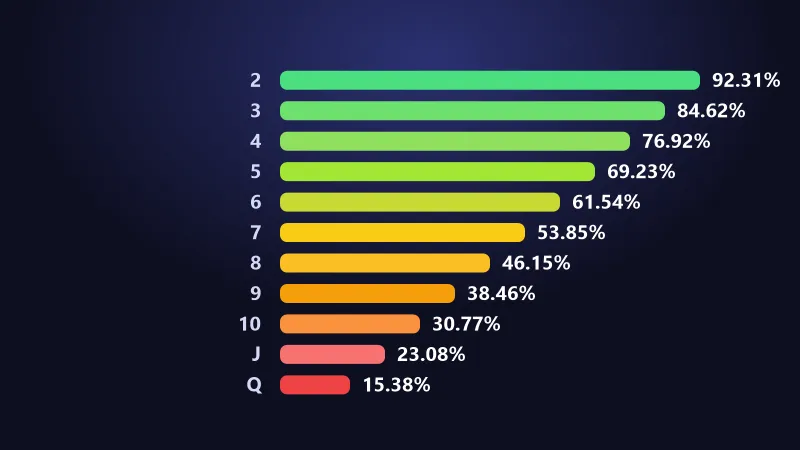
The pattern is symmetric. A 7 gives 53.85% either way and pays 1.85x either way. Each step away from 7 makes one side safer and cheaper, and the other riskier and richer. Nothing in the table is a free option.
What is the house edge in Hilo?
By our arithmetic, the panel's multipliers match 99.9% ÷ probability, cut to two decimals. For example, 99.9 ÷ 76.92 gives 1.29x. That formula means a 0.1% edge per guess. This is our reading of the panel, not a figure Duel states.
The cut matters a little. Take the shown multiplier times its probability and you get a return of between about 99.23% (the 1.29x at 76.92%) and 99.85% per guess. We can't tell whether payouts use the rounded multiplier or the full value, so the edge on a single guess could be somewhat above 0.1% if Duel pays the rounded figure. That is a limit of our reading.
Edge is charged on every guess, so a long round pays it many times. Our house edge explainer covers why total wagered matters more than any one bet.
How likely are long runs?
Lower than most players expect. Hilo pays more for each extra card, but every extra card is another chance to lose the whole stake. The table multiplies the per-guess chance by itself. It is our calculation.
| Chance per guess | 5 in a row | 10 in a row |
|---|---|---|
| 92.31% | 67.0% | 44.9% |
| 76.92% | 26.9% | 7.3% |
| 53.85% | 4.5% | 0.2% |
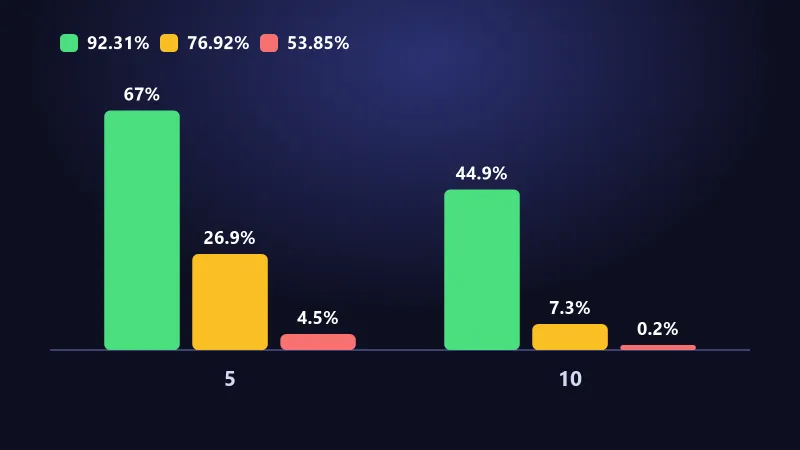
Even at 92.31% per guess, the safest play, 10 in a row happens less than half the time. The 1.08x it pays per card is small, and it is the price of a high chance, not a bargain. Chasing a long run at 53.85% a guess works out to 0.2% over 10 cards, about 1 round in 500.
Which Hilo strategies are myths?
Card counting
It doesn't work. Duel's verification code draws each card independently from a full 52-card deck, keyed by client seed, nonce and cursor. Earlier cards leave no trace, so there is nothing to count.
"Due" cards
Ten low cards in a row don't make a high card more likely. Each draw is the same 13-rank draw. The same logic applies to the start card: it is chosen by the player and not drawn, so it carries no information about what comes next.
Always taking the safe side
Safe guesses are cheaper to be right on, not free. At 92.31% you win often and are paid 1.08x, so one miss erases many small gains. A safe choice lowers variance. It doesn't remove the edge, which stays near 0.1% per guess on the panel's numbers.
Skip Card
Skip Card swapped the current card for a new one when we pressed it logged out. It changes which card you face, not the edge on your guess. A skipped card is gone and the next one is another independent draw. Skipping only changes which odds and multipliers you face on the table above, not their price.
Progressions
Raising your stake after a loss changes how much you risk next, not the edge. Our Martingale article shows why that arithmetic breaks down in a losing streak.
How do you check a Hilo round is provably fair?
The bet panel has a Provably Fair link. Provably fair means a result can be checked afterwards using cryptographic seeds rather than trusted. Our provably fair explainer covers the concept.
For Hilo, Duel's verification page lists the cards for a given nonce. It shows the next 50 cards for that nonce, each generated with HMAC-SHA256 from your seeds, nonce and cursor. To check a result yourself, open the Verify tab on Duel's Provably Fair page, choose Hilo and enter your client seed, server seed and nonce. Our provably fair page explains the steps; its own verifier currently covers Blackjack only. Verification shows the cards came from the seeds. It doesn't tell you whether the multipliers are generous, so the formula above is the real check on the price.
Does Zero Edge Hilo count for the leaderboards?
No. Duel's economics changelog says leaderboard points are paid in proportion to the net edge, so zero-edge bets earn none. The Hilo panel has a Zero Edge button, and Duel labels its Originals as 100% RTP up to the limits shown in the bet panel. Our zero house edge explainer covers what that does and doesn't mean.
Standard-mode Hilo bets can earn points, but each guess costs about 0.1%. Don't wager more to climb a table; only the top places are paid. Our leaderboards guide has the pool sizes. If you play other Originals, the Keno guide and Limbo guide use the same kind of arithmetic.
Responsible play
You must be 18 or older, and you should check that online gambling is legal where you live. Losing is the normal outcome, because the edge is never in your favour, and a multiplier that keeps climbing is exactly why people play past their limit. Set a stake and a loss limit before you start, and stop when you reach either. If you want to try the game, you can sign up to Duel through our link. Never bet money you need, and never raise your stake to win back a loss. Our responsible gambling page lists limits, warning signs and free help.
Duel Hilo FAQ
Is there a maximum multiplier in Duel Hilo?
Duel's rules say there is no maximum payout multiplier, only bet and profit limits. Check the limits in the bet panel before you play.
What does the same rank do in Hilo?
On middle cards, the same rank also wins, at a lower payout. On an Ace or King, you choose between "same" and the one direction that is possible.
What is the house edge in Hilo?
About 0.1% per guess in standard mode, from our arithmetic on the panel's multipliers. Whether payouts use the rounded or the full multiplier is something we can't tell, so the real figure per guess could be a little higher.
Does card counting work in Hilo?
No. Every card is an independent draw from a full 52-card deck, so past cards tell you nothing about the next one.
Does Skip Card improve my odds?
No. It swaps the current card for a new one. The edge on your guess stays the same.
Do zero-edge Hilo bets earn leaderboard points?
No. Duel's economics changelog says zero-edge bets earn no points.
Duel facts in this article were checked on duel.com on 21 November 2026.